
IS ALAN MOORE OVERRATED?
A Time Twisted Genius

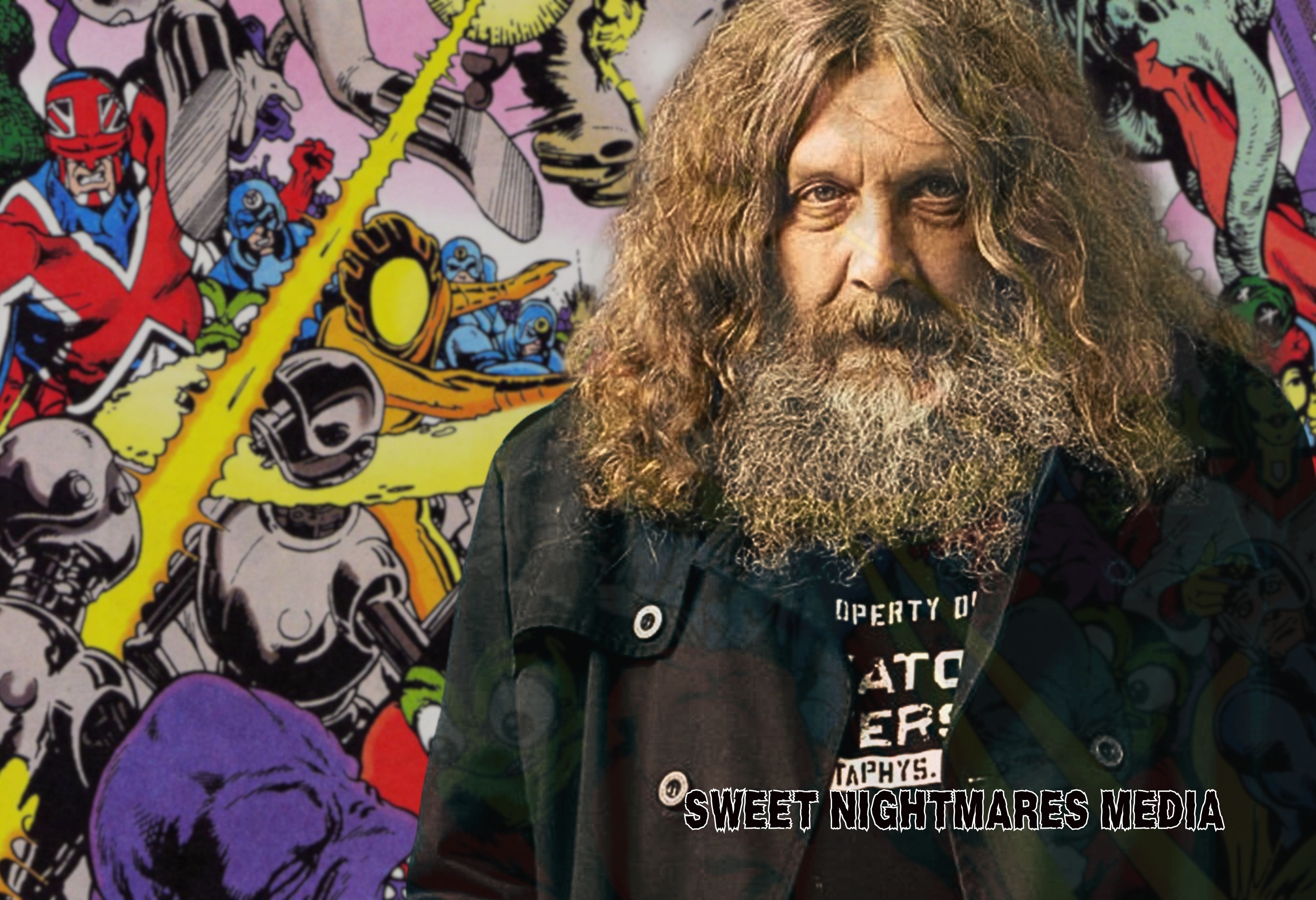
If you listen to comics podcasts, like the The Awesome Comics Podcast or Mega City Book Club one thing is almost a given. Listen for long enough and you will hear one name and, typically one title mentioned.
Alan Moore, and Watchmen.
There is little doubt that Watchmen is a classic, often cited as the greatest graphic novel of all time. Although some fans will remember collecting the individual issues episodically, back in the day. Most of us first experienced the story in the collected edition.
I’m not a comics historian so some of what I say here, from memory, might be inaccurate—I’m sure you nerds will be happy to correct me in the comments—I believe it was from around 1985 when The Dark Knight Returns, Swamp Thing, Watchmen and, a little later, Sandman were released. These titles, amongst a few others—many of which followed on from the so-called British Invasion—created the ‘comics for grown ups’ market. Of course, there had been comics aimed at adults around for years, but they weren’t snobbishly rebranded as graphic novels. Which is probably why they didn’t get reviewed in The Guardian newspaper—the vanguard of middle-class post-grad faux activism and cultural fartiness.
This era is widely regarded as the death of comics as we knew them. Alan Moore himself hated the term ‘graphic novel,’ and Pat Mills has cited the collector market as the cause for the decline of western comics in the late twentieth century.
But this isn’t an article about that. Go and Read Comic Book Punks, by Karl Stock if you want to learn more about that era, which burned so bright but faded so quickly. This is my random thoughts about one of the most respected writers to ever create a comic.
My Intro to Moore
I first saw Moore’s name in the credit box of a Tharg’s Future Shocks story in prog 303—the first 2000ad I bought with my own money. It was obvious to ten-year-old me that whomever this writer was, he was very clever. 43 years later Tharg’s Future Shocks still appear in the prog from time to time. They mostly suck. That’s not a criticism of the writers, I just think it’s a now defunct format. How can anyone possibly write a 4-page thriller with a shocking twist that hasn’t already been done better by Alan Moore, Alan Grant, or Grant Morrison, etc?
Back in those days, British weekly anthology comics would run strips that were, usually, 4-6 pages long. An ongoing story might have run for as many as 25 episodes (progs). But Moore had mastered the short, sharp shock format. You can buy a whole collection of his Future Shocks, Time Twisters, and more: here.
I grew to recognise his name. I think the first ongoing story of his that I read in 2000ad was Skizz. A very British, working-class take on the film, E.T. This was common in those days. Many for the strips running in British comics were inspired by films and TV. It was like a way of giving kids more palatable versions of the stuff their parents were enjoying. Jaws, Dirty Harry and The Dirty Dozen had all inspired popular comic strips in the 70s and 80s. 2000ad itself was created explicitly to cash-in on the popularity of some random, kids’ sci-fi movie that no-one has heard of since… Star Wars, I think it was called…
Anyway. I wasn’t a fan of Skizz at the time. It was quite talky, too grounded in reality, and, being set in modern day, working-class Birmingham (Moore’s home city) it felt out of place in a Sci-Fi comic featuring the likes of Judge Dredd and Rogue Trooper. But when I revisited it a few years later, I could see the brilliance of it. A great, character driven story about a teenage girl who felt out of place in her hometown, forming an unbreakable bond with an Alien who was very much out of place on Earth. It’s not Moore’s best work by any stretch, but you can see all the Moore elements forming here. Well worth a read if you haven’t heard of it and can get your hands on a copy.
DR & Quinch is, in my opinion, among Moore’s best work, featuring outstanding artwork from a young Alan Davis. It’s an example of just how funny Moore could be. The Bo-Jeffries Saga from the pages of Warrior being another example of Moore’s early comedy work. Sadly, Moore himself has since distanced himself from DR & Quinch, claiming that the violence for comic effect has no lasting value.
I’ll get to Watchmen in a bit, and I’m going to skip the full bibliography and career retrospective, that’s not what this piece is. He also wrote some incredible one-off shorts for various 2000AD annuals, including the exceptional ABC Warriors: Red Planet Blues with Steve Dillon. But it was while he still wrote for 2000AD that he produced his first (and in my opinion best) masterpiece work.
The Ballad of Halo Jones was a uniquely, Moore-esque story of life in a far-future housing estate called The Hoop. It was, again, heavy on dialogue, low on action. It was a damning analogous critique of Thatcher’s Britain, the decaying inner cities, the jobless plight of the working classes and the repetitive mundanity of life, told through the eyes of a depressed teenage girl, who was desperate to escape.
So, she went out.
Never to go back.
Wonderfully illustrated by the late great Ian Gibson—sadly, the reprints have all been recoloured, which does an injustice to the original art, in my opinion. Unfortunately, the saga never saw its planned conclusion, ending at book three, after Moore fell out with the publishers of 2000AD over creator rights. Britain’s loss was America’s gain.
Verbose Genius, or Pretentious Over-Writer
I think it’s fair to say that Moore is one of the most recognisable names in comics, not quite a household name outside of comics circles but probably a familiar name to many. If you had asked me in the mid eighties who my favourite comics writer was, I would have said Alan Moore. I loved Halo Jones and his initial run on DC’s Swamp Thing and The Killing Joke. 13-year-old me thought this, alongside Frank Miller’s The Dark Knight Returns was peak comics storytelling. As the years have gone by, my opinion has changed a little.
That’s not to say I no longer rate Moore, I really do. But if I was forced to list my favourite, or most personally inspirational comics writers I would list John Wagner, Alan Grant, Garth Ennis, Pat Mills and probably Frank Miller, too. There are others, but I feel like these guys, Wagner, and Grant especially, who have inspired me the most as a writer.
Alan Moore, it seems, was always trying to re-define comics writing, to push the medium, to find new ways of doing visual storytelling. At-least, that’s what he would say. But, in my opinion, he was a novelist posing as a comic writer. You only need to take one look at his scripts to realise how artist unfriendly he was. Although, in his defence, when I met Brian Bolland a few years ago, I asked him whose scripts he preferred to draw, Wagner’s or Moore’s. He said Moore’s because Moore’s scripts were so detailed they left nothing open to interpretation. I suppose there really is no right or wrong way.
There’s a lesson there for aspiring comics writers. Speak to your collaborators, where possible, and write a script to suit their preferences.
Anyone who has ever read a Moore script will know what I mean when I say ‘density.’ Most comic writers will write a paragraph of description per panel—in the case of John Wagner, not even that much! But not Moore, no, he wrote a page of description per panel. This is a method that was employed by some other writers, too. Moore mentored that Sandman bloke, and his scripts are similarly dense. I’ve not read much of Grant Morrison, but I have seen some pages of script from Arkham Asylum which were pretty close in density to Moore’s. You’ve probably heard how Moore’s co-creator of Watchmen, Dave Gibbons, famously used a highlighter pen to pull out the line or two of description he needed to know for drawing the scene. What makes those scripts even more interesting to read is how they are all hand typed and full of typos and corrections. They’re a bit of a mess to be honest. I sympathise with the artists. But let’s be fair, Moore must have been doing something right because so many of his books are cold classics.
I suppose it’s a little like that weird nodding head thing that Marathon runner Paula Radcliffe used to do. You certainly wouldn’t coach that to a young athlete but coaching it out of Paula might have made her slower!
Enough about the scripts, they are what they are. Let’s talk about his writing in general.
I think there’s little doubt that Moore is a master storyteller. Many writers have tried to emulate his style and failed miserably. When you aren’t, yourself, a genius and you try to write in the style of a genius you will end up looking like a twat.
Moore’s stories are almost always intricate, tangential and make heavy use of misdirection to subvert your expectations. That, I am certain, was a skill he honed while writing those early 4-page shockers for 2000AD.
But his writing, like his scripts, is dense. There is one chapter in From Hell that features two characters on a carriage journey around various London landmarks, as one character reveals all the hidden secrets in London’s high society. It’s massive speech balloon after massive speech balloon. It breaks all the rules. Typically, we are told that a panel should have no more than three balloons or text boxes and no more than about 25 words per balloon/caption. There are panels in this sequence that have a balloon which takes up half the page. Yes, it’s over written, it’s verbose, but, somehow, it works… just!
Where I have a slight issue with Watchmen—as great as it is—isn’t so much the density and verbosity of the storytelling. It’s the pages of text at the end of each chapter. 3-4 pages of a wall of text that is written with Moore’s trademark loquaciousness. More of a projectile vomited word-salad than necessary context or nuance, which takes you out of the comic experience. This, in my opinion, isn’t reinventing comics, it’s shitting all over the medium and feels somewhat disrespectful, not least of all to the artist.
I don’t know if he was the first to do this, I’m sure comics historians can educate me in the comments. But he most certainly wasn’t the last and, to this day, certain comics writers do this, thinking it makes them look clever, but it almost always feels pretentious to me. If you want to write a prose story, write a prose story, but keep comics as a visual medium.
That’s my opinion, other opinions exist.
This density of storytelling in Moore’s books is one of the reasons that I very rarely re-read any of his American comics. Every time I pick up Watchmen to re-read it, I am reminded of the task ahead of me and put it back on the shelf. I don’t feel that way about his 2000AD works, and it is for this reason that I still consider The Ballad of Halo Jones to be his best work.
In many ways, Moore’s comics are like David Lynch’s films. A multi-sensory experience that often breaks convention. Now, whenever we recognise elements of the Lynch formula in offerings from other filmmakers, we call it Lynchian. Lynch himself, had become the genre. Perhaps it’s the same with Moore.
The fact that Moore now considers himself to be a wizard who casts magic spells with words perhaps indicates that his eccentricity has evolved to the point that he has disappeared up his own sphincter. I’m sure he wouldn’t care what I think.
Final Words
Wrapping this up, I want to make it clear that I am not saying there is a right or wrong opinion here. These are my thoughts and feelings. I absolutely respect Alan Moore and his body of work. Some of his later stuff is mind-blowing but, the density of his writing makes everything a challenge. I do like talky comics, I love beautifully written dialogue, and I don’t mind when comics are ‘over-written’ if they are written well. But the writer needs to let the art breathe. The writer, I feel, has a duty to leave room for the artist to tell as much of the story as their own words. I feel that the special relationship between the dialogue heavy story and the subtlety of the artwork can combine to tell a compelling story—Dan Abnett is known for this, occasionally Ennis, too—done right, it feels less ‘over written’. Get it wrong and it becomes a chore to read. I also love when a writer sets their ego aside and trusts the artist to do the heavy lifting, especially in action sequences. That’s a lesson I have learned from working with talented artists, that fewer words sometimes works better for the purpose of the comic reading experience.
Moore, at times swamps the reader. Other, lesser writers, bore the reader and their comic would benefit from 50% less words. Which is exactly what Alan Grant told Moore when he was working as a sub editor on 2000AD and read one of Moore’s submissions found in the ‘slush pile’. Sadly, Alan Grant is no longer with us. But, even if comic fans are unaware of his contribution to comics as a writer, they all should be aware that he is the man who gave Moore his big break.
It’s fair to say that Moore changed the way many people look at or think about comics creation, and he inspired a generation of writers. I just sometimes wish he had applied that first piece of advice.
What is your favourite Alan Moore comic? Let me know in the comments.
By the way, there’s no Alan Moore related content there, but I’d appreciate it if you checked out our online merch store at SN-Media.redbubble.com
Troy
I don't think Moore was a "novelist posing as a comic writer" as much as he was an writer/artist who found himself more regularly employed as a writer. He can draw quite well, and I think as a result, knew exactly what he wanted his scripts to look like in comic form, and tried to convey that to the artists he worked with in as much detail as he could. You could definitely say he was a bit of a control freak! I don't think he was overrated, or took himself too seriously at all. He wrote consistently great stories across many genres, and there are very few, if any, other comic writers you can say that about.
I'd recommend seeking out the stories he did on Supreme, they're a perfect homage/parody/pastiche of Silver Age Superman stories, and the stuff he did with his America's Best Comics line at Wildstorm is phenomenal!
Alan Moore is Alan Moore. He is not without his flaws or faults but what distinguishes him is that he stuck to his guns and principles. That being said, I can count his best work on the my fingers and most of it is all top tier. This is what differentiates him from most... he walked away before he could phone it in and get some quick cash.