
THE WARNINGS WE IGNORED
1980S COMICS AND NOW.

Have you ever noticed the irony in how people who self-identify as ‘truthers’ are almost always interested in a version of the truth that can rarely be confirmed by evidence?
In politics and in the media the truth has often been served with a liberal sprinkling of elaboration and a dollop of ideology on the side. I think it’s quite important in today’s world of polemic online discourse—which is amplified by a media that increasingly deals in outrage and polarisation to drive engagement-based profit—to remember to ask ‘what evidence is there for this claim?’ One should remember that, sometimes, two, or more truths can exist.
We used to call that nuance.
With the increasing politicisation of almost every topic from public health to the colour of one’s hair and beyond, it seems that every discussion becomes a tribalistic butting of heads, where differing opinions or counter-arguments are taken as a personal attack, or virtue signal that must be met with hostility.
As we transition from an era of extreme market consolidation to technological centralisation, it may seem that this atmosphere feels uniquely modern, but the anxieties underpinning it are not.
In the 1980s, a comics revolution was underway and creators were producing seminal works shaped by cynicism and dystopian anxiety.
Concerns about rising authoritarianism, crumbling social safety nets, market fundamentalism and conspiratorial rage were informing stories that diagnosed the same societal tendencies that are amplified today.
So let’s talk about it.
DID YOU MISS THE SUBTEXT?
1980s Anglo-American comics used dystopia, satire and deconstruction to expose authoritarianism, neoliberal dehumanisation and populist rage. Rather than functioning as blueprints, these works almost operated as cultural stress tests. Had John Wagner, Alan Moore or Frank Miller written a story set in 2026 about a massive global conspiracy organised by a small group of some of the richest and most influential men in business and politics—men who consider the cost of labour to be a “tax on productivity”, who believe liberal democracy is impeding their personal freedom to exploit the planet and accumulate even more wealth; men who want to replace human labour with AI robots and use the majority of us as cattle for their strange pseudoscientific “longevity” projects in order to unlock immortality and live like gods—that would have been a pretty sick dystopian sci-fi horror story.
Except they didn’t write that story. This is what appears to be happening right now, beneath our noses.
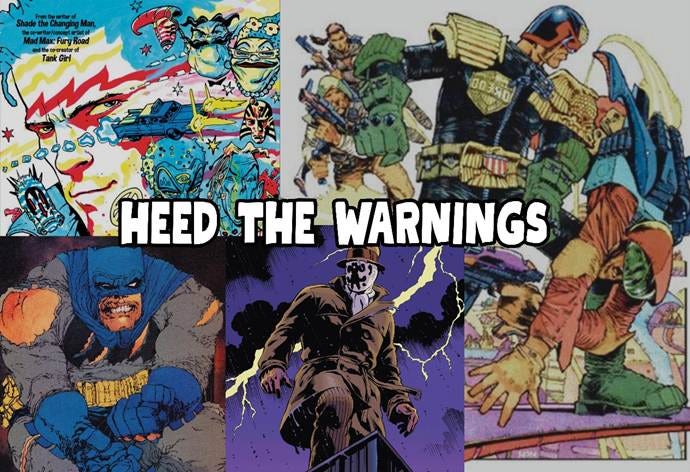
This year sees the 40th anniversary of Frank Miller’s Batman: The Dark Knight Returns. This was actually the first Batman comic I ever read, having only seen the classic (but admittedly silly) television series. Miller’s Dark Knight was a visionary tale of a dystopian near-future version of a middle-aged Bruce Wayne who dons the cape and cowl once more to fight the rising tide of street gang crime, while working at odds with the police department and, indeed, the government. Vigilantism has been outlawed, Superman is now a government prop, and superheroes like the Green Arrow have become domestic terrorists. Miller’s version of Gotham is dark, mean and authoritarian. Batman represents the right-wing edgelord who positions himself as a “strong-man” lone gun on a one-man mission to do the work the state has failed to achieve.
This idea—that street crime is some kind of unavoidable cancer on society that must be met with force—is the foundation of 2000 AD’s Judge Dredd. Dredd was the satirical embodiment of neoliberal authoritarian attitudes to justice at all costs—but not justice in the sense of fairness or due process. This is an oppressive, aggressive, state-level system of militarised policing where almost everything is a crime. Judge Dredd is the logical end point of that: judge, jury and executioner who dispenses instant “justice” at the squeeze of a trigger. He’s Dirty Harry meets the Gestapo.
To understand how Judge Dredd came to be, one must understand the political environment in the UK in 1977, when the character was first published. The country was facing an energy crisis, high unemployment and a highly organised labour movement that saw the nation grind to a halt in the face of mass industrial action. In the background, however, was a growing populist right-wing narrative that the people were at fault, that they had “had it too good”, to directly quote Margaret Thatcher.
By the 1980s, under Thatcher’s government, the trade unions had been weakened, UK industry and coal mines—therefore a huge source of income for working-class families—were being shut down and natural resources sold abroad. As unemployment soared and new taxes were introduced, public discontent was met with increased policing and expanded powers of arrest, including wider stop-and-search laws. Yes, the 1980s had neon colours, tacky music and hairspray, but there was also grey brutalism, long dole queues and plenty of neoliberal gaslighting. Judge Dredd was John Wagner and Carlos Ezquerra’s critique of that.
In a recent podcast interview, when asked how he felt about the fact that Judge Dredd now looks like a blueprint for US authoritarianism and federally mandated vigilantism against its own people, Wagner seemed both sad and angry. What had started as his way of making sense of the nasty politics of the day, in the form of satire, now appears prescient and sinister.
2000 AD wasn’t alone in satirising the state. The Comic Strip Presents…, which gave the world comedy legends such as Robbie Coltrane, Rik Mayall and Dawn French, was a highly satirical adult series that became known as “alternative comedy”, because classism, racism and sexism were apparently considered mainstream.
So while Frank Miller was asking questions about institutional failure and positioning Batman as a parody of the libertarian idea of a “strong-man” populist who takes matters into his own hands—he literally leads a gang of neo-Nazi-looking street thugs to become his own private vigilante force that does a better job than the police—he was also inviting deeper questions about the ethics and effectiveness of rigid law and order. Most social academics would agree that street crime is often symptomatic of a failed society and the erosion of social safety nets that drive poverty. Some might argue that the real criminals sit in Congress, Parliament or in corporate boardrooms.
A couple of years after The Dark Knight Returns, Alan Moore and Dave Gibbons’ Watchmen was published.
This was a subversion of the superhero genre that questioned the morality of allowing a small group of individuals to wield enormous power and influence. One character feels especially relevant today. It might be argued that he embodies what we now refer to as incel culture: a morally rigid and violent reactionary shaped by extremist objectivism and a heightened sense of trait disgust. Rorschach is undoubtedly the most compelling character in the series, but he is not a good man. A noir-like detective who hides behind an ever-changing mask, he appears to care about society’s ills, yet his inner monologues reveal a darker psychology that echoes Travis Bickle in Martin Scorsese’s Taxi Driver. Where Rorschach feels most contemporary is in his radicalisation by the far-right newspaper The New Frontiersman, a publication promoting conspiracy theories and reactionary social agendas.
Let’s circle back to Thatcher’s Britain and discuss a lesser-known British comic from the pages of 2000 AD. Sooner or Later was a psychedelic and surreal satire on the plight of the working class in Britain in 1986. Written by Peter Milligan and illustrated by Brendan McCarthy, it begins with the protagonist, Micky Swift, being told to “get on your bike”. He travels through time and is forced to find work to pay his way home, despite there being no jobs available. Ironically, he finds himself in a future where no one but the ruling elite actually has a future. It is a clear metaphor for the hopelessness of working-class Britain at the time.
Today, we see a mega-rich corporate class extracting wealth from society while telling the rest of us to work harder and stop wasting money on luxury items like avocados. Hustle culture insists that you simply need to work more, work harder or get a better job—but wages stagnate and opportunities shrink. Increasingly, people feel like cogs in a machine: if you are not producing value for the shareholder, you are deemed useless. In that context, it is no surprise that the arts are often targeted for cuts; individual expression and authoritarian neoliberalism sit uneasily together. In many ways, Sooner or Later, a single-page strip published weekly, is not far removed from Terry Gilliam’s cinematic fever-dream, Brazil, which similarly uses surrealism and absurdist concepts to satirise capitalisms uglier aspects.
The most recent 2000ad Thrill-cast has an interesting discussion about Sooner or Later: HERE
WRAPPING IT UP
It would be all too easy to believe that these incredible comics had predicted the future, but that’s not quite the case. They were mapping patterns and critiquing aspects of the societies in which they were created. Anyone who has ever read a history book can tell you that history often repeats itself. Systems of oppression work so well for a select few who exploit them that they become tried-and-tested processes, highly effective and difficult to dismantle.
If you look at these four comics individually, each shines a light on different aspects of that system. Taken together, however, they offer a much clearer vision of the bigger picture. From Miller’s Dark Knight and its cynical view of working-class crime and systemic failure, cross-referenced with Judge Dredd’s condemnation of authoritarian structures, you begin to see how broken the system truly is. Add to that the absurdity of Micky Swift’s desperate situation in Sooner or Later, and Rorschach’s reactionary accusations that society’s decay is caused not by the abusers of power but by those at the bottom of the ladder—left with little option but to scramble for a foothold on the lowest rung.
Collectively, these works show us that uneven power structures, social inequality and exploitation are sustained when reactionary forces redirect blame towards the victims and manufacture culture wars among the masses as a distraction from the corruption and dishonesty at the top.
It worked in the Roman Empire. It worked in Victorian Britain. It worked in twentieth-century China. The mechanisms do not change — only the branding does. The more uncomfortable question is not whether the pattern is repeating, but whether we are mistaking it for normality.
Anyway, that’s my thoughts on it, but what do you think? Let me know in the comments if you agree or disagree, or if you have anything to add to the discussion.
Troy
I’m always down for social commentary in my comics :)